
In recent months, central banks around the world have embarked on a concerted effort to combat the specter of rising inflation by aggressively raising policy interest rates. While the goal is clear – to cool down overheating pockets of the economy and rein in inflationary pressures – the consequences of such a move are far from uniform. This non-uniformity arises from a combination of factors, primarily the limited scope of central bank actions and the inherent lags in the transmission of monetary policy. Consequently, the impact of higher interest rates varies greatly depending on who you ask. Quantifying the precise extent of these transmission lags is not an easy task, and this, in my view, explains why we see so many differing opinions about the potential return of a recession. So let’s do our best to come up with a more accurate assessment.
A scary picture without context
It is indisputable that higher interest rates increase the cost of borrowing for all economic actors, including individuals, businesses, and governments. Today, those who need to secure loans urgently find themselves grappling with prohibitive borrowing costs. Consider the current data for the US economy, which is the most advanced in the rate hike cycle:
- Credit cards loan rates have surged to over 20%.
- The average rate for personal loans and new auto loans stands at 11.48% and 7.59% respectively.
- Average 30-year Fixed rate for a mortgage is 7.18%
- The average coupon for new issuances by investment-grade rated companies exceeds 5.0%
- The yield on US 10-year notes is currently at 4.33%.
Consumer borrowers, for instance, are hit by elevated rates on credit cards, personal loans, and new auto loans. These immediate effects can be particularly burdensome, but they do not represent the full extent of the story.
The majority of debtors, especially those who borrowed before the interest rate hike, are not immediately subjected to the stress of higher rates. This is where the intricacies of monetary policy transmission come into play. The effect of higher rates is neither immediate nor equally felt across all sectors of the economy. Its primary influence is on new demand, which is marginal compared to the existing stock of debt.
Consider the following statistics:
- The median cost of a 30-year fixed-rate mortgage for existing homeowner is between 3 and 4%. More than 9 in 10 mortgage holders have a rate below 6%.
- Estimated net interest paid by non-financial corporations as a percentage of outstanding debt is currently around 3.0%.
- Average interest rates on Treasury securities paid by the US government is: 2.84%.
These figures reveal that we are still a considerable distance from the 5.50% policy rate set by the Federal Reserve. While the direction is clear, the pace of change is moderate. The effects of these elevated rates are likely to manifest at a later stage, particularly when existing debtors face the need to refinance their current loans or seek new borrowing opportunities.
This leads to the pressing question: When will these effects be felt, and how severe will they be?
Households, businesses, or government: Who will suffocate first?
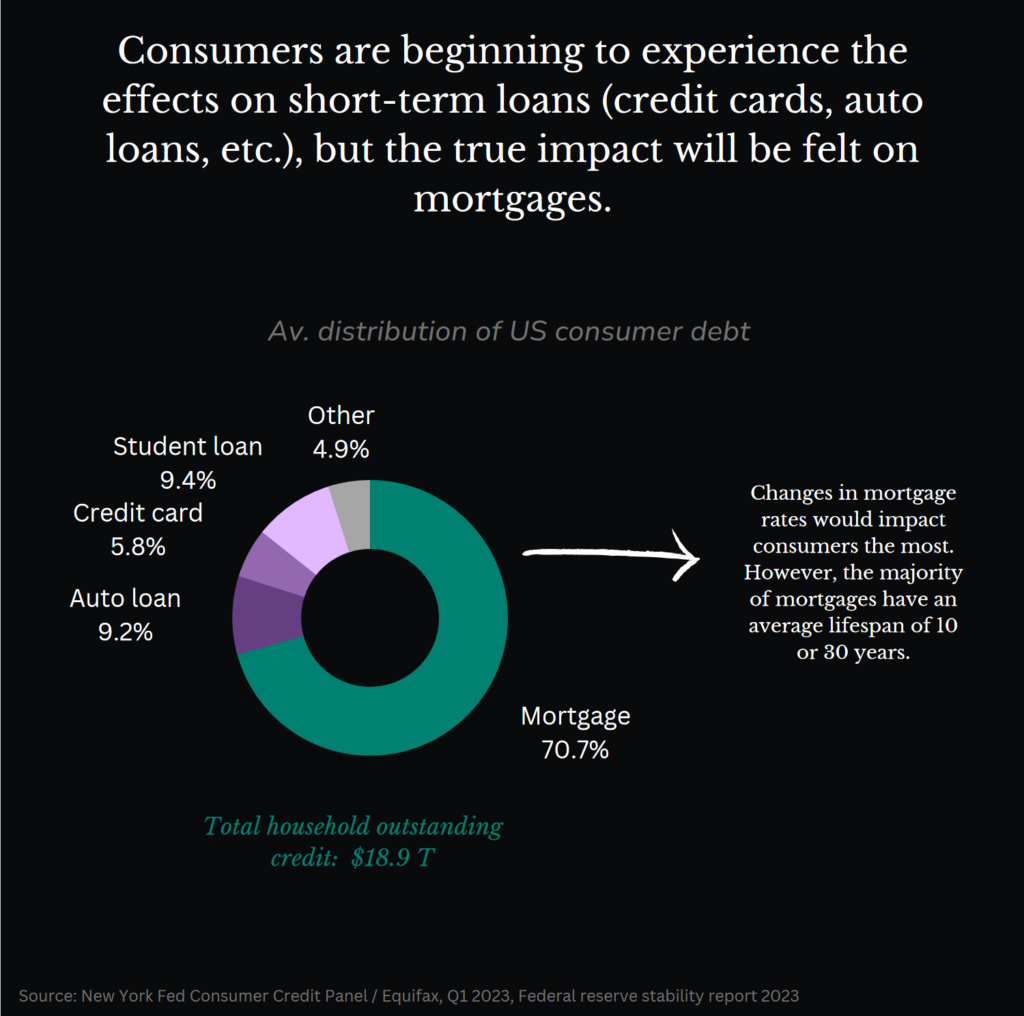
Let’s begin with households. Indeed, consumers are starting to experience a strain on their budgets. The impact on credit card loans and auto loans, which typically have short maturities, has already begun to manifest. However, these types of loans collectively account for less than 15% of household debt, on average. The real deal are mortgages that represent 70% of household debt, this is where the impact will be the most pronounced. Households could be affected in two ways: if they have to refinance their existing loans or engage in new borrowing, or if home prices take a hit. When it comes to maturing mortgages, terms are quite spread in time as the majority of mortgages come with an average lifespan of 10 to 30 years. As for maturing mortgages, the terms are spread over time, with the majority carrying an average lifespan of 10 to 30 years. So far, home prices have remained relatively stable, and we have not yet reached a tipping point.
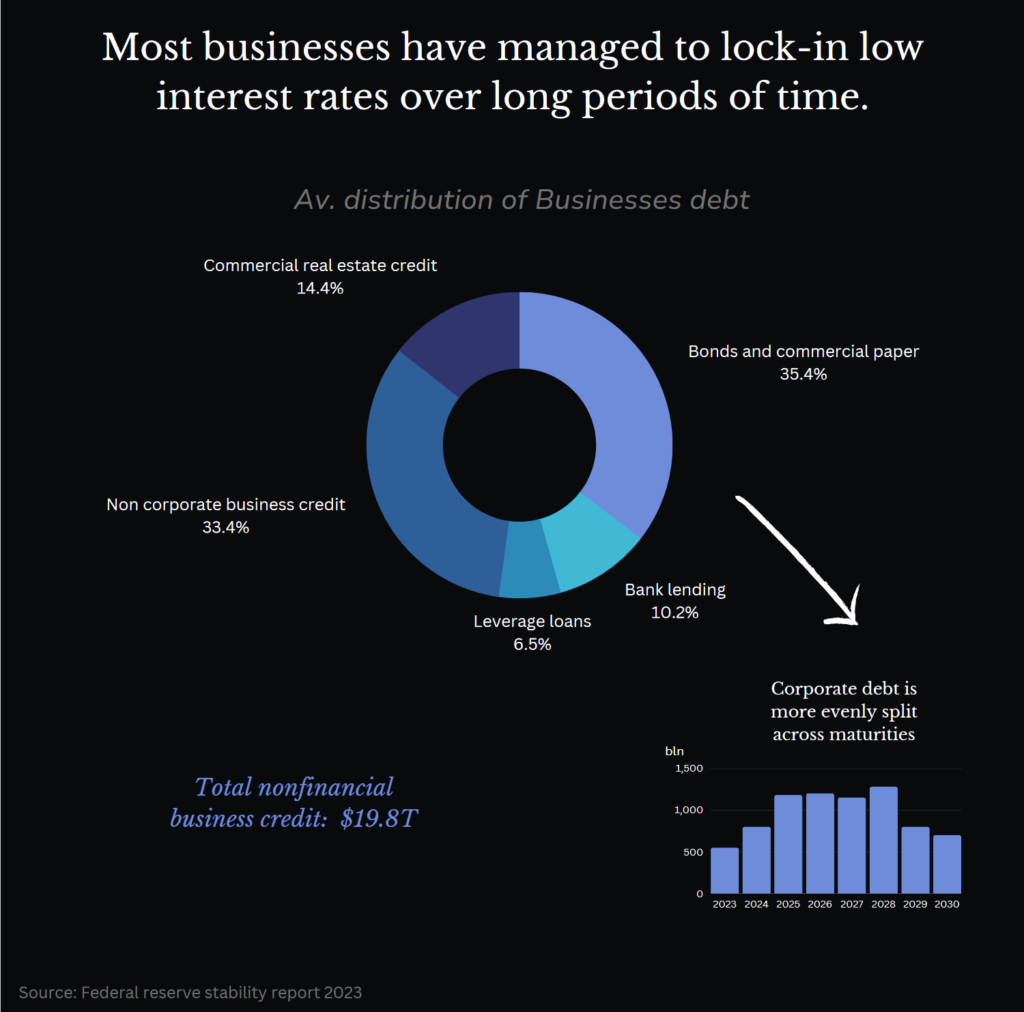
Let’s turn to corporations now. The total non-financial business credit is amounting to $19.8 trillion demanding our close scrutiny. Here again the impacts have been mitigated. Most businesses have been proactive in managing their exposure to interest rate risk by locking in low interest rates over extended periods. Additionally, outstanding debt is quite evenly distributed across various maturities, mitigating the immediate impact of rate hikes. While the pressure will keep increasing as time passes – the rating agencies are already forecasting a rise in default rates – the tipping point is still a few months away.
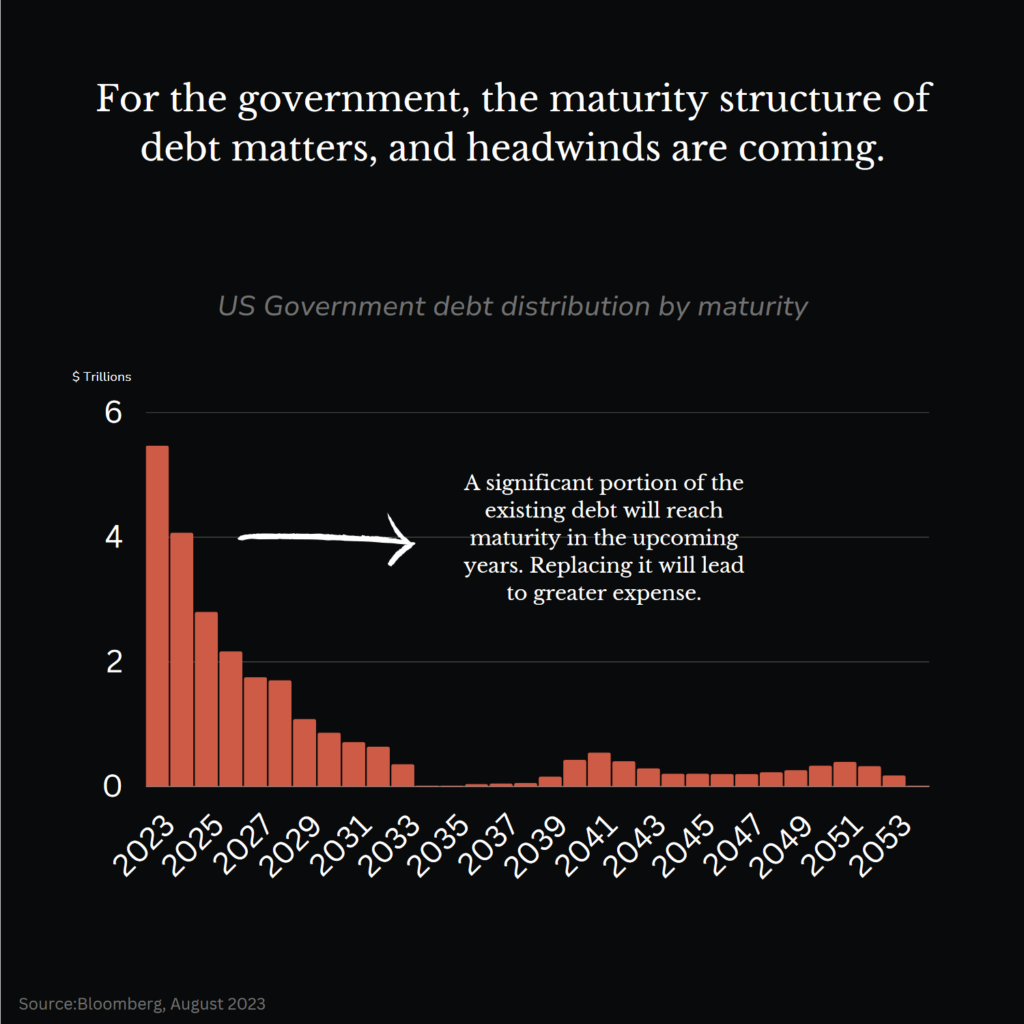
This brings us to the government sector, where the situation is more concerning. When it comes to interest rate changes, the government faces unique challenges. A substantial portion of its existing debt is scheduled to mature in the upcoming years. Replacing this debt with new issuances in a high-rate environment will translate into increased expenses, potentially exerting significant pressure on public finances.
Conclusion: Prolonged and pervasive as opposed to pronounced
If interest rates remain elevated, it is only a matter of time before the broader economy starts to feel the full effect of Central Bank decisions. How much longer can economic agents withstand this pressure? At least a few more months, although most governments will soon start to feel the impact. In light of this, it is fair to expect slower growth for longer. Lags in transmission combined with sustained period of higher rates suggested prolonged and pervasive effects but the severity is still in the hands of Central banks. At least for now. To conclude with a more local perspective: economic conditions in Switzerland exhibit some differences. Interest rates are lower, government debt maturity is better distributed over the upcoming years, but there is a reason for concern regarding the real estate market.