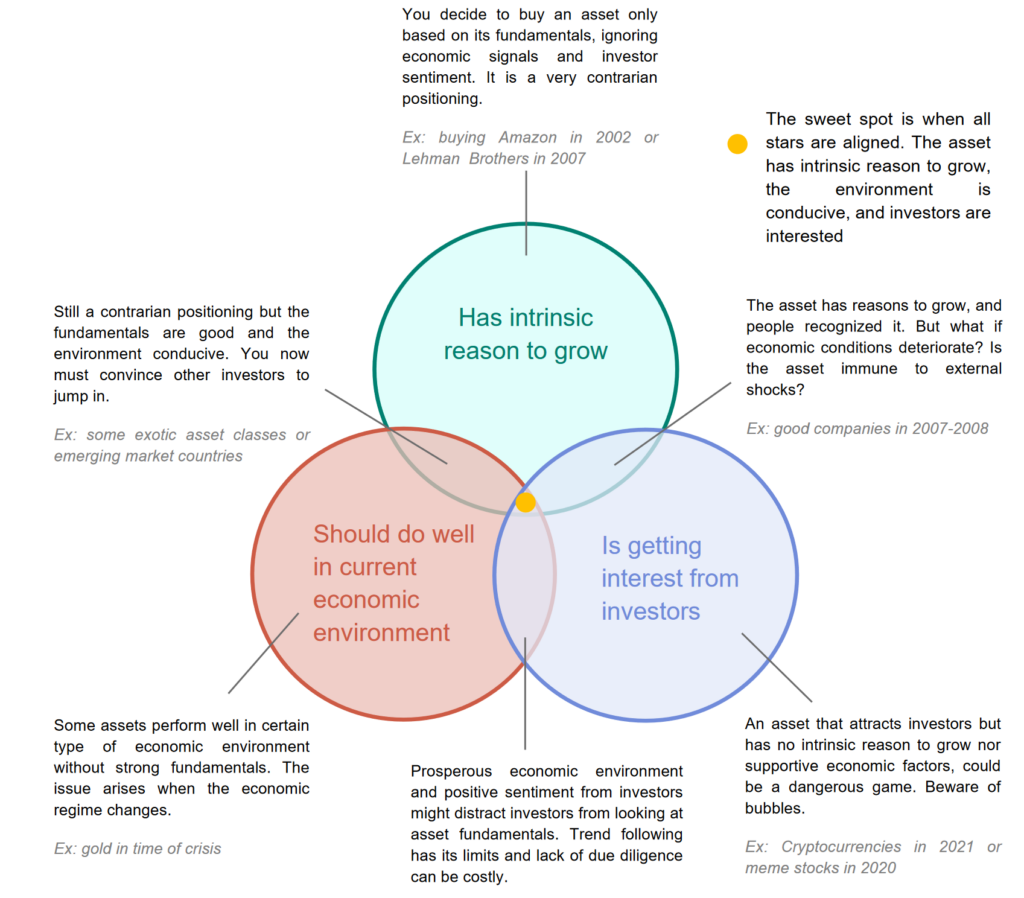
The foundation of any meaningful investment strategy is a clear vision. One that can be communicated,
debated and, more importantly, translated into action. Here I am about to introduce you to the framework I use for assessing investment opportunities.
Can a simple investment research framework answer with 100% accuracy whether or not to buy or sell any asset? It certainly cannot! A good framework should be practical and have a good discriminatory power.
Is this framework novel? Barely. Mankind has invested for millennia, and it would be unreasonable not to tap into the wealth of economic and investing theories that great thinkers have developed over time by great thinkers. So yes, I borrow concepts while adding my own touch. My objective is to be relevant, rather than new.
The three questions for you to answer
Understanding whether or not an asset is likely to grow in value usually means figuring out three things:
- Are there intrinsic reasons for the asset to grow?
- Is the external environment conducive to growth?
- Are other investors likely to be interested in the future?
One general observation I’d like to make is that most investors tend to focus on one of these three questions when assessing assets. For example, value investors assessing companies will try to isolate market noise and focus their efforts on determining the company’s ability to generate cash over time. On the others hand, traders will pay more attention to flows and investors sentiments. Economists tend to take helicopter views.
Is one of these angles more important than the others? That’s a conclusion we will avoid jumping to, for two reasons:
- First, there is no strong empirical evidence that one of these three forces drives the price of assets any more than the other two. (And the corollary is that no single investment style consistently outperforms over time).
- Second, assets, economies and people are interconnected in so many ways that it’s dangerous to ignore entire sets of insights. For example, who would have thought in 2008 that the slowing of the US real estate markets could lead to the collapse of the Icelandic banking system?
Are there intrinsic reasons for the asset to grow?
All assets – companies, commodities, collectables, digital assets, precious metals, debt, real estate, etc. – have their own unique ways of demonstrating promise. It’s up to an investor to figure out if the opportunity in front of them holds these characteristics. One way to do this is to understand the intrinsic reasons for the asset to grow over time. A sort of “in-vitro” thought experiment in which we take the asset out of its economical context and study its ability to create value and generate cash.
It is a purely theoretical exercise of course, but removing variables such as the investors from the equation for a moment helps understand what are the natural drivers of the growth and the dynamic at play. For example, some assets have inherent reasons to grow while others rely more on interest from people (a well-established company with revenues vs. a young artist selling paintings). The drivers of growth differ from one asset to another but the question always remains valid. When we consider collections of assets (like indices or economies), the question can also be answered by aggregating the individual drivers.
Is the external environment conducive to growth?
Even companies with sound business models and rare pieces of real estate can suffer in times of economic hardship. In the case that inflation is rapidly rising, or there’s an economic downturn, downward pressures can weigh on the price of the assets. The key question to ask here is, “What is likely to occur in the wider environment the asset operates in?” Each asset has a specific place in the economic fabric and is influenced by a large set of factors. To name a few of them:
- Resources: most assets are made from or use raw materials and commodities. The ease of access to
these resources and the affordability of their prices are key. Reduced availability can cause supply
shock, inflation and shifts in demands – affecting the price of assets over the short and long term.
- Economic landscape: Governments play a vital role in setting policies that will influence the allocation of resources, shape the economic landscape and nudge consumers towards saving, spending or investing.
- Geopolitical climate: All it takes is a couple of economic sanctions to turn the best assets into the worst. Commercial wars, poor trade agreements, geopolitical shifts, and inclusion and withdrawal from trade unions can have severe consequences on asset prices.
- Funding and liquidity: a strong economy requires a financial system that allocates funds in a frictionless and homogeneous fashion. For most companies, bank loans (and nonbank loans and bonds to some extent) remain the most important source of external financing as opposed to stock markets. It is thus important to have a financial structure that promotes economic efficiency. Many factors can reduce the efficiency of a financial systems (high transaction costs, inefficient regulation, asymmetric information, poor collateral management, credit crunches), and this can have disastrous impacts on the funding and the economy… as we saw in 2008.
The broader economic environment can influence assets in many ways. That’s why it is critical for investors to assess how conducive it is. Assets are rarely isolated from noise
Are other investors likely to be interested in the future?
An asset’s price typically reflects people’s expectations. That’s why we have trends, bubbles and crashes. This means it’s critical to analyse how you think other investors will view the asset in the years to come. The question we are trying to answer is: “How much will the next buyer be willing to pay for it?”.
If all the good intrinsic reasons for an asset to grow have been discounted in the price, there’s a chance that the asset hasn’t got much more room to grow. At the other end of the spectrum – even if an asset has fundamental reasons to grow and is trading at a low price, you still have to be able to convince others that it’s a gem. There is a strong relationship between the value of an asset and its price.
For example, a strong company with a spiralling market price will be affected in many ways: executives are less incentivised to stay, cost-cutting policies impact the organization, there are difficulties in raising funds…a low price can turn a good company into a bad one. And the contrary can be true as well.
We may thus pay attention to a couple of factors for assessing people’s likelihood to have an interest in an asset and try use it to our advantage.
- The price of the asset itself. Our internal valuation systems take prices as an input. They are powerful
anchoring points we refer to in the absence of other indicators. And “shadow” prices (not real prices
based on transactions, but estimations and projections) are sometimes even more powerful, especially when the liquidity is lower. Thus, it is interesting to factor in prices in two ways. First, as a point of comparison to the value of the asset that we have established “in vitro”. Secondly, As an indication of what the crowd thinks.
- Stories. Forecasting crowd behaviour is almost impossible, but it is ultimately the mass of people who cause fluctuations in asset prices. That’s why it is important to follow the development of certain narratives. Stories are ultimately what get us to invest so tracking the prevailing content and its emotional charge and the emergence of new contrary narratives is helpful. To quote Robert Shiller: “Economic narratives are contagious. They suggest scripts for people to follow, they repeat their messages and they strive on human interest”.
- Investors’ mood. Investors’ moods are likely to reinforce price movements. In some extremely depressed or euphoric environments, it is almost possible to feel the “market’s mood”.
- Flows. Monitoring the positioning of the other market participants (Smart money, institutional, retail
investors) can help us gauge the strength of a trend.
- Liquidity and ease of trading. When an asset is grabbing attention, it is easier to trade it. Brokerages
firms promote it, they feature in the recommendation lists of investment teams, and they are granted higher loanable values by credit teams.
These are some of the factors to take into account when assessing the overall interest from other buyers. Ultimately, before buying an asset we should already have identified the potential buyers who will buy it from us at later stage.
Take your time, don’t rush to conclusions
To summarize: understanding whether an asset is likely to grow in value or not means figuring out three things:
- Are there intrinsic reasons for the asset to grow?
- Is the external environment conducive to growth?
- Are other investors likely to be interested in the future?
These simple questions can help you separate assets that show potential from those that don’t. As tedious as it may seem, conducting a thorough analysis of an investment opportunity is time well spent. Often, the investor’s quickest road to ruin is ignoring the research process and instead either replicating what has worked for others in the past or buying into the opportunity that is currently grabbing the most attention.
This framework is my basis for conducting investment research. It promotes diverse thinking. Asking for feedback and talking to other investors who have different viewpoints is also a good way to become aware of my own biases and incorporate additional elements into my analysis.